
v0.1LATEST
- Constraint-based 2D sketcher driven by a Newton-Raphson solver
- Seventy-two geometric and dimensional constraint types
- Degree-of-freedom analysis that drives entity colour and the DOF overlay
A focused, parametric 2D sketcher built around constraints, precision, and clear feedback.
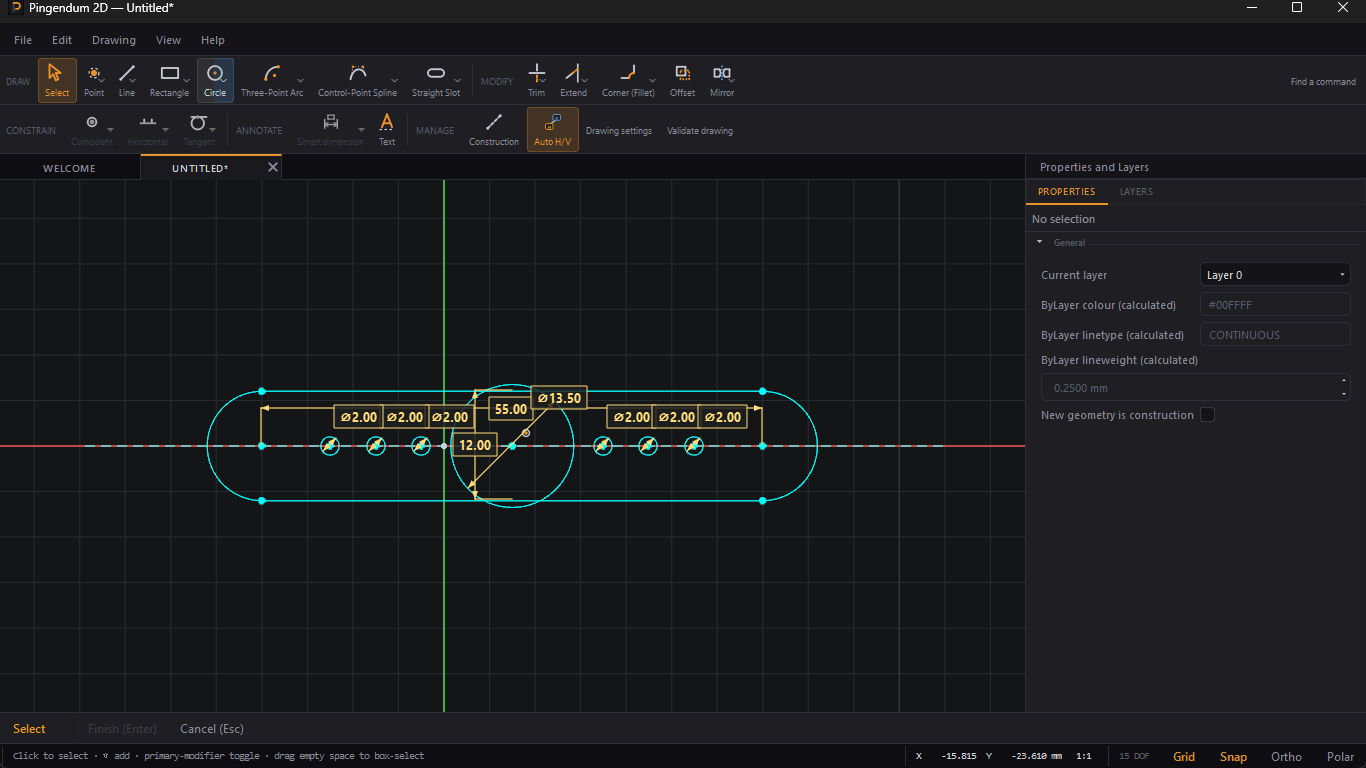
The degree-of-freedom count tells you how much freedom is left, and unconstrained geometry stays cyan until you pin it down.
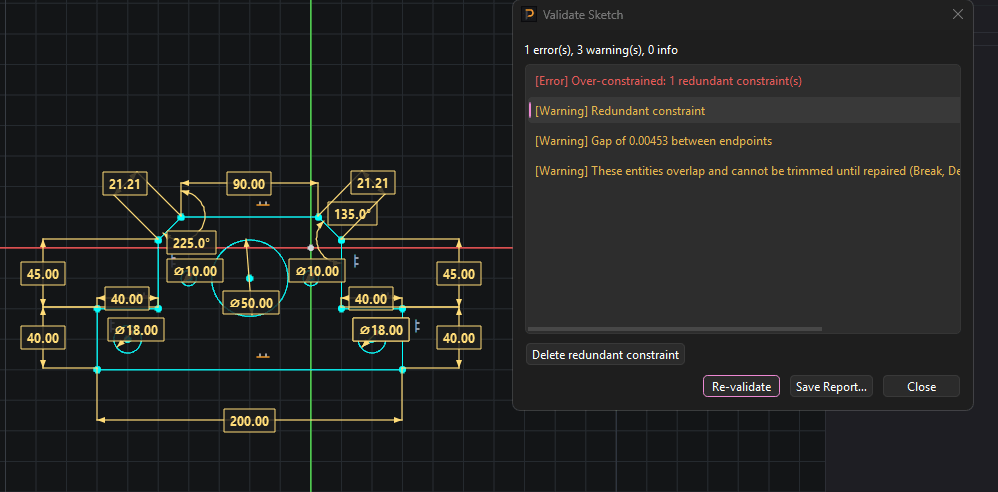
When constraints clash, the panel marks the specific ones that are redundant instead of failing the whole solve.
Validate Sketch names duplicate lines, overlaps and open contours before they break a downstream feature — and offers the repair.
Dimensions drive the geometry. Change a value and everything constrained to it follows, exactly as you defined it.
The solver re-runs after every edit and reports what the sketch has left to pin down. Under-constrained gives you the count. Over-constrained tells you how many constraints are redundant. A genuine conflict is named as its own state rather than hidden inside a failed solve. One readout, four answers — so a sketch that will not resolve tells you which kind of wrong it is.
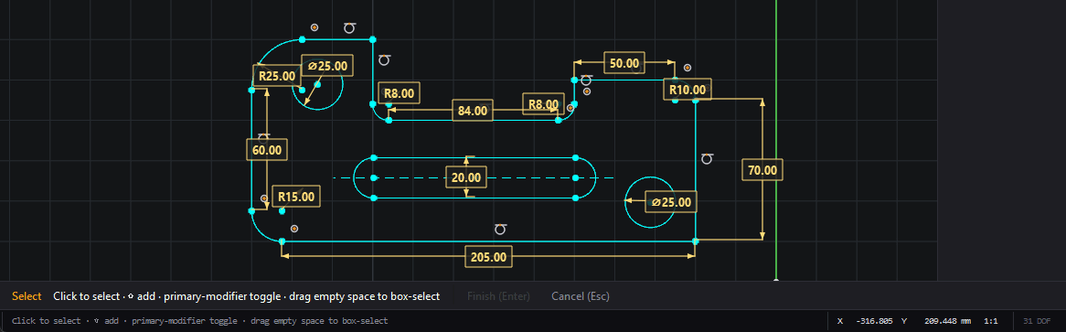
A contradiction does not fail the whole solve. Pingendum separates a genuine conflict — a new constraint the sketch cannot satisfy at any size — from mere redundancy, names the one constraint at fault, and offers to delete precisely that one. You remove the constraint you meant to remove, not the one you guessed at.
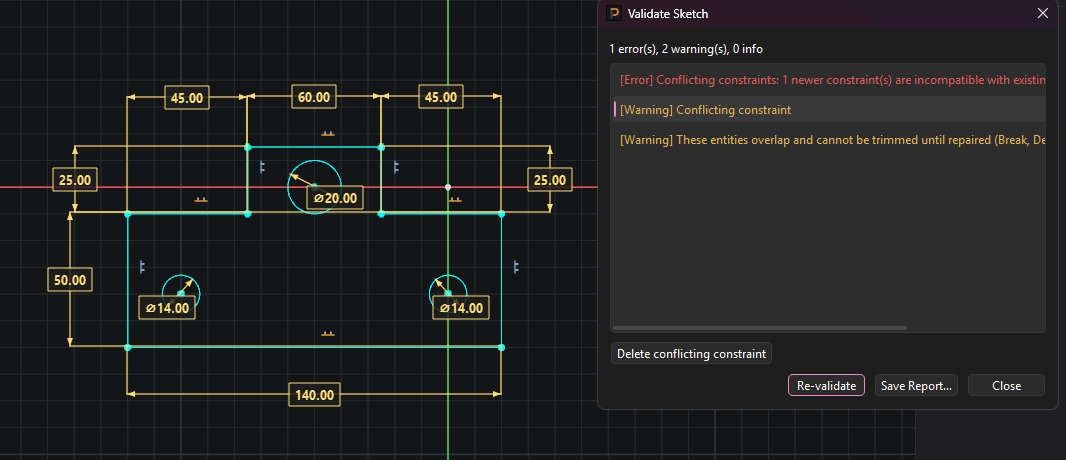
Validate Sketch names every problem it finds — redundant constraints, duplicate lines, entities that overlap and cannot be trimmed until repaired — and offers the repair alongside it.
Draw the profile.
Change what you have drawn.
Define how geometry relates.
Give it numbers, and read what is left.
Pingendum is launching with the 2D sketching environment. It is the part that is finished, so it is the part being released.
Geometry, the full constraint toolkit, degree-of-freedom feedback, diagnostics, grid snap, drafting aids and reference dimensions.
Pad, pocket, revolve, fillet, chamfer, shell and patterns are already built. They are not what this first release is for, and will arrive in a later build with the documentation that covers them.
Projects save to Pingendum’s own versioned format. Drawings import and export as DXF — R12 or R2000, geometry on layer 0 and construction geometry on its own layer — though dimensions and constraints are not carried across, because DXF has no way to represent them. Drawings also plot to a PDF sheet or a printer at a real scale, with an ISO title block and hidden, frozen and non-plot layers left off the paper. There is no DWG, STEP or STL export.
On the long-term roadmap only. Neither is promised for a date, and neither is being sold to you today.
Work beyond the sketcher is tracked in the changelog as it lands, and the documentation covers the sketcher chapter by chapter.
The 2D sketcher is being prepared for its first release. Join the waitlist to be notified when early access opens.
Pingendum is under active development ahead of its 2D release. Every update is logged — no silent changes.